
RIICO, LAND, AND RAJASTHAN’S UNANSWERED QUESTIONS
As Bhairana Dham burns with protest and the High Court issues notices, the state’s industrial juggernaut is finally meeting its match — the people it displaces
Written by Akankhya Samal, Research Scholar, IIM Mumbai
Ground Reporting: Mukesh Kharwal, Lalita Choudhary
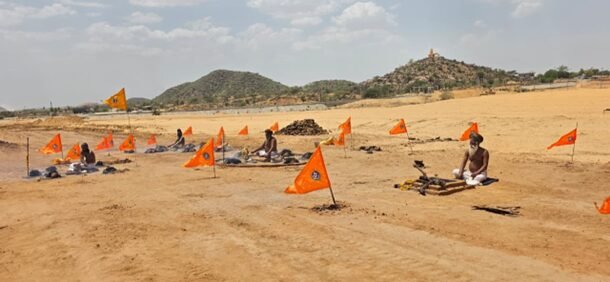
Sadhus and saints sit in protest at Bhairana Dham grounds, surrounded by saffron flags, as the Aravalli hills loom in the background. Day 41 of the dharna. Photo: Munder News
In December 2024, Jaipur lit up for the Rising Rajasthan Global Investment Summit. Chief Minister Bhajan Lal Sharma presided over a spectacle of ambition — over 35 lakh crore rupees worth of MoUs signed, industrialists flown in from across the country, and the promise that Rajasthan was finally ready to shed its image as a tourist economy and emerge as a manufacturing powerhouse. The Rajasthan State Industrial Development and Investment Corporation (RIICO) was handed the keys to that transformation.
Six months on, the triumphalism has quietened. What has emerged in its place is a far messier, more consequential debate — one that pits the imperatives of industrial growth against the rights of those who stand in its way. And nowhere is this tension more nakedly visible than in RIICO’s land acquisition and allotment machinery.
Nowhere is that tension more raw than at Bhairana Dham, Pashchim Rajasthan — where for 41 consecutive days, farmers, villagers, saints and sadhus have sat in scorching 42-degree heat in what they call a do-or-die protest. Our reporters Mukesh Kharwal, Lalitha Choudhary, and Rakesh Kumar have been there through it all. What they witnessed is not a fringe agitation. It is a civilisational question about whose consent matters when governments decide to industrialise.
| “Either remove RIICO, or we do not move. This is not a protest — this is a battle for our existence.” |
THE CASE FOR: A STATE THAT CANNOT AFFORD TO STAND STILL
Let us be clear-eyed about what Rajasthan is up against. The state is India’s largest by area, yet punches far below its weight economically. Its industrial GSDP grew from ₹2.25 lakh crore in 2018–19 to ₹3.58 lakh crore in 2023–24 — respectable progress, but still modest relative to states like Gujarat, Maharashtra and Haryana, which have transformed their economic identities through exactly the kind of corridor-led industrialisation that RIICO now seeks to replicate.
The logic of RIICO’s Direct Land Allotment Policy 2025 is, in isolation, sound. The old auction-based system had long been criticised by industry for inflating land prices and discouraging investment, particularly among smaller enterprises. The new policy eliminates minimum investment thresholds, introduces a lottery-based system for MSMEs, allows payment in installments — 25% upfront, the rest over three years — and promises land allotment within three weeks of application. These are not cosmetic reforms; they are structural changes that could genuinely lower the barriers to industrialisation.
The ambition is visible on the ground too. The Jodhpur-Pali-Marwar Industrial Area, spanning 3,600 hectares, is being developed to attract ₹19,000 crore in investments across solar components, textiles and engineering. RIICO’s push to establish industrial corridors along national highways — inspired by Gujarat’s Delhi-Mumbai corridor and Haryana’s Gurgaon-Manesar model — reflects a coherent, if borrowed, vision. Between April and May 2025 alone, RIICO sold 182 of 197 offered plots, generating approximately ₹300 crore in revenue. Cumulatively, allocated land value has crossed ₹650 crore.
Supporters argue that a state with high unemployment, persistent rural distress and chronic underinvestment cannot afford to be sentimental about speed. Land, they say, is the foundation of everything else. Without it, the MoUs remain ink on paper, the jobs remain promises, and Rajasthan remains what it has always been — a state of scenic poverty.
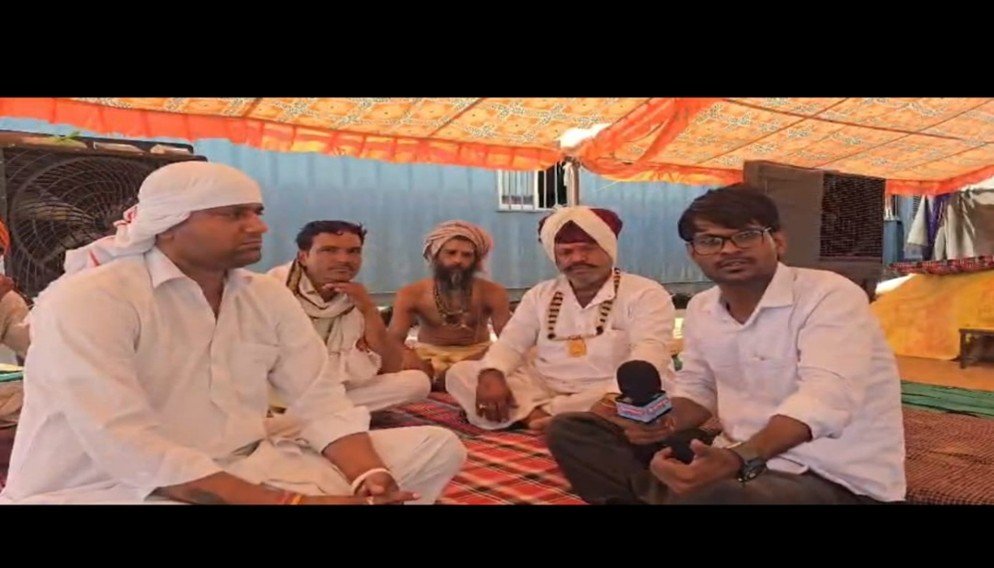
Reporter Mukesh Kharwal interviews protest leaders under a tent at Bhairana Dham.
Photo: Munder News
THE CASE AGAINST: WHOSE RAJASTHAN IS RISING?
But here is what the glossy summit brochures do not show: farmers sitting neck-deep in mud pits in Jaipur, protesting what they call forced land acquisition at rates far below market value. That image — raw, desperate, anachronistic — is not from another era. It is the lived reality of what happens when the machinery of industrial development is not adequately restrained by the rule of law and the rights of the dispossessed.
The Direct Land Allotment Policy 2025 has triggered precisely this anxiety. By bypassing the competitive auction mechanism in favour of discretionary allotments to MoU signatories — a self-selecting group of investors who attended a government-curated summit — the policy creates a closed circle of beneficiaries. Critics ask, with legitimate force: who determines which MoUs receive priority categorisation as ‘A’, ‘B’ or ‘C’? On what basis are certain industrial areas deemed ‘saturated’ and thus excluded from the scheme? Where is the public register of allotment decisions?
These are not merely procedural concerns. The Rajasthan High Court itself, as recently as March 2026, issued notices to both the State of Rajasthan and RIICO in a PIL challenging the constitutional validity of the Rajasthan Land Revenue (Amendment and Validation) Act, 2025 — a piece of legislation that critics argue was crafted to retrospectively validate RIICO’s land acquisition actions and shield them from judicial scrutiny. That a court has found sufficient cause to examine whether RIICO’s statutory powers are being exercised within constitutional bounds is a fact that should concentrate minds.
| “Wherever development projects are introduced, ecology and environment are always the first to be ignored. If RIICO comes to Bhairana Dham, local biodiversity, air quality, water and soil will be destroyed. A major part of the Aravalli range will get disturbed. Even a 1% reduction in forest cover raises PM2.5 levels significantly. The temperature could rise by 5–6 degrees. The environmental catastrophe will be worse than our imagination.” — Dr. Sandeep Kumar, Senior Research Fellow, Air Quality & Climate Change, School of Environment and Sustainable Development, Central University of Gujarat |
The land acquisition question goes deeper. When RIICO asks district collectors to earmark agricultural land along national highways for industrial corridors, farmers do not receive market-rate compensation — they receive DLC (District Level Committee) value, which in rural Rajasthan can be a fraction of actual land worth. The Land Acquisition Act of 2013 was designed precisely to correct this historical injustice, requiring social impact assessments, consent clauses and rehabilitation plans. But the implementation of these protections has been, to put it generously, uneven.
There is also the question of what happens after the land is acquired. RIICO’s own rules set a three-year deadline for production commencement, with extensions available for a penalty. But for how many past allottees have those deadlines been enforced? Rajasthan is dotted with RIICO-allotted plots that have lain idle for years — acquired at reserved prices, their industrial potential unrealised while the original farming families have long since dispersed. If the government cannot ensure compliance from those who already hold land, the case for accelerating fresh allotments is considerably weakened.
Finally, consider the environmental dimension. Rajasthan is a state of fragile ecology — arid, water-scarce, with the Aravalli Hills facing sustained assault from mining and development. Industrial corridors carved through agricultural belts and ecologically sensitive zones carry consequences that three-year project timelines cannot capture. The state’s history with the Aravalli mining dispute, which dominated political discourse through 2025, should have been a cautionary lesson.
| “We used to come for festivals. Dadu Dayal Ji Maharaj’s Bhairana Dham has been our sacred ground for generations. With RIICO comes pollution. There are hundreds of other places to set up industries. Why here?” |
GROUND REPORT: MUNDER NEWS AT THE DHARNA
For 41 consecutive days, Munder News reporters Mukesh Kharwal, Lalitha Choudhary, and Rakesh Kumar documented what may become one of the largest protests in Rajasthan’s recent history. What follows is their account.
A Mahapanchayat has been convened. Saints and sadhus — many elderly, some ailing — have assembled in the open. The temperature outside is 42 degrees Celsius and there is no shade, no respite. Yet no one leaves. ‘It’s a do-or-die situation,’ one protester tells our reporter, tears forming before they can be blinked away. ‘Either remove RIICO, or we don’t move.’
The Pashchim Rajasthan side of the region has already borne one wound: the government has cut down trees where animals used to shelter. Barren land now stretches where forests once stood. ‘This is not the Rajasthan we grew up in,’ says a senior villager from Munder. ‘The government calls this development. We call it destruction.’
Protesters say their grievances are twofold: environmental concern and religious sentiment. Bhairana Dham is not merely a parcel of land — it is a sacred site where devotees of Dadu Dayal Ji Maharaj have gathered for centuries. The prospect of industrial pollution reaching a pilgrimage ground is not an abstraction for these people. It is a desecration.
‘People say there have been many such protests in history,’ says one protester, ‘but the government must respect the people and the religious saints. What will future generations say if we let this happen on our watch?’
THE UNCOMFORTABLE MIDDLE: WHEN BOTH SIDES ARE RIGHT
The tragedy of the RIICO debate is that both sides are partly right, and both are partly dangerous in their certainty.
Those who argue that Rajasthan must industrialise at speed are correct that a state cannot lift its people out of poverty by standing still. Employment generation, infrastructure creation, and fiscal revenue are not abstractions — they are the difference between a young person staying in their village and migrating to Delhi slums.
But those who warn that the current model of land acquisition and allotment is opaque, inadequately compensatory and potentially unconstitutional are also correct. Development that displaces without adequately compensating, that allots without ensuring utilisation, and that legislates to insulate itself from judicial review is not development — it is dispossession with a press release.
| “Development that displaces without compensating is not progress. It is dispossession with a press release.” |
What Rajasthan needs — and what RIICO has not yet demonstrated it can provide — is a model where industrial ambition and agrarian justice are not treated as mutually exclusive. That means genuine social impact assessments, not procedural box-ticking. It means compensation at market rates, not DLC value. It means publicly auditable allotment decisions, not closed-room discretion dressed up in MoU language. And it means a RIICO that actively tracks and enforces production timelines on existing allottees before racing to acquire new land.
The Rising Rajasthan summit was a fine spectacle. What rises next depends on whether the government is willing to do the harder, less photogenic work of building systems that protect the people from whom that rising is extracted.
If it is not, then what rises will not be Rajasthan — only its real estate.
| ABOUT THE AUTHOR: Akankhya Samal is a Research Scholar at IIM Mumbai specialising in Economics. This investigation was reported by Munder News ground reporters Mukesh Kharwal, and Lalita Choudhary, Views expressed are personal. |