
C R I S I S R E P O R T · W E S T E R N RAJ AST HAN· GR OUND INVESTIGATION
Munder News, May 2026
The Thirst That Never Ends
Has India Forgotten Its Own Desert?
“Four million people have suffered. The aquifers are collapsing. The ground is sinking. Women stand outside government offices with empty pots, four kilometres from a dam, and are told: “Your problem is as per your village’s problem.” The government has known since 1987. And still, every morning, the women walk.”
Reported by: Mukesh Kharwal & Rakesh kumar | Munder News, Bilara Tehsil, Jodhpur
Written by: Akankhya Samal
She is almost fifty years old, though she looks seventy. Walks four kilometres every morning across cracked white earth – a clay pot on her curved spine, a muddy pond shared with cattle at the end of it – to collect what passes for water in her village in Jodhpur district. When asked if she worries about drinking it, she laughs. “Worry? We are dying from it. What is there left to worry about?”
What is happening across western Rajasthan – in Bikaner, Churu, Nagaur, Barmer, Jaisalmer, and Jodhpur – is not a natural catastrophe. The Thar Desert has always been arid. What is unfolding today is something far more shameful: the compounded ruin of neglect, corruption, and a political class that has spent four decades promising water and delivering poison. This is a crisis manufactured in government offices, accelerated by bad policy, and paid for in broken bones and abandoned villages by people who had no say in any of it.
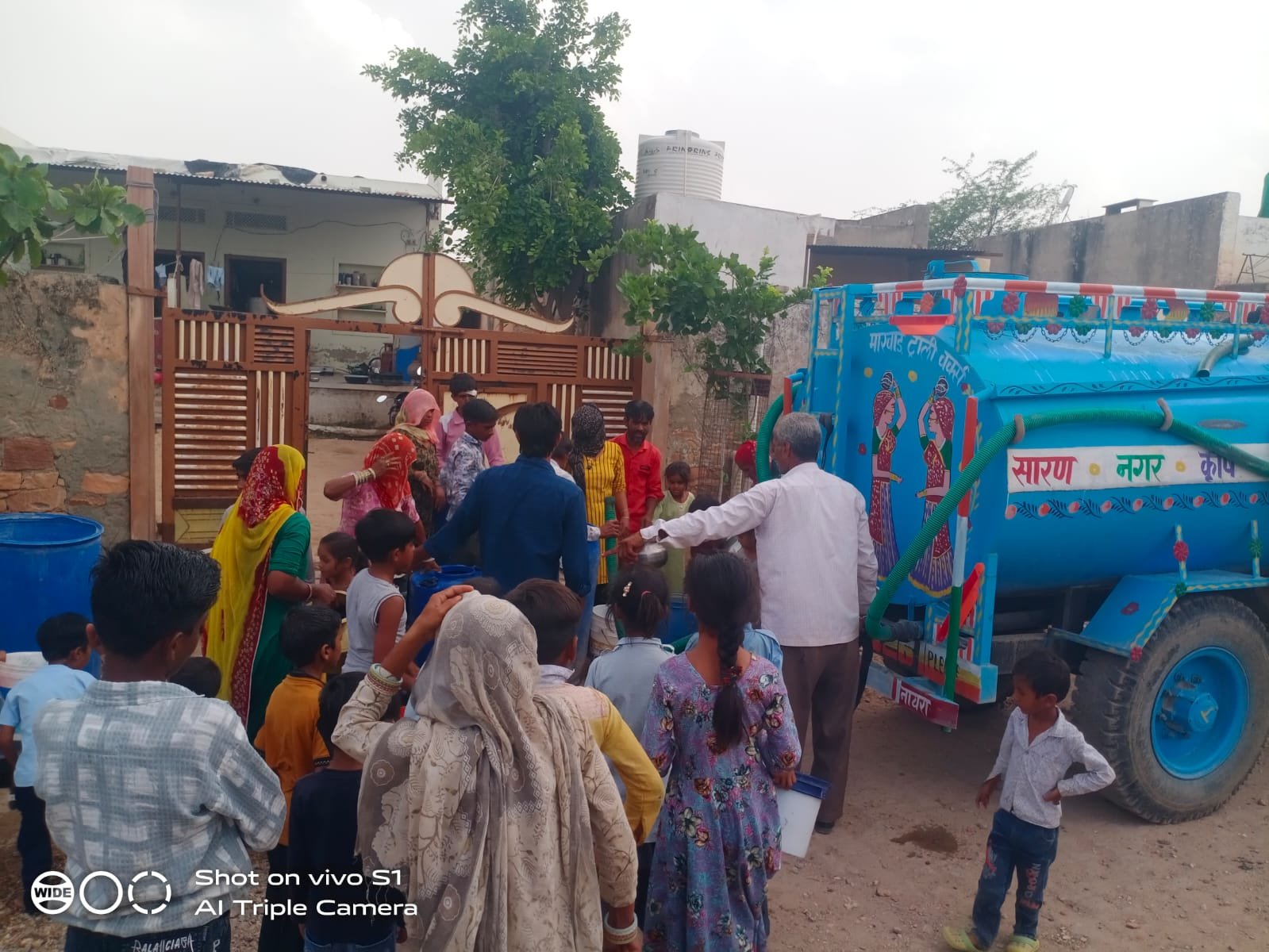
FOUR KILOMETRES FROM A DAM, EIGHT DAYS WITHOUT WATER
To understand how complete this failure is, you need only go to Pichiyak village in Bilara tehsil, Jodhpur. It sits four kilometres from the SDM office. It is close to a court, to colleges, to schools. Most strikingly, it stands on the banks of Jaswant Sagar – the largest dam in Jodhpur district, built on the Luni River, a water body visible from the village itself. And for the past six months, its residents have had almost no water at all.
In the most recent week before this report was filed, the women of Pichiyak’s three neighbourhoods – the Muslim mohalla, the Chowkidar basti, and the Naik ki basti – had not seen running water for eight consecutive days. When rain fell, they ran outside with every vessel they owned: pots, buckets, drums, whatever could hold water. They drank rainwater off their rooftops. They rationed. They managed. Because management – not supply – is what the government has left them with.
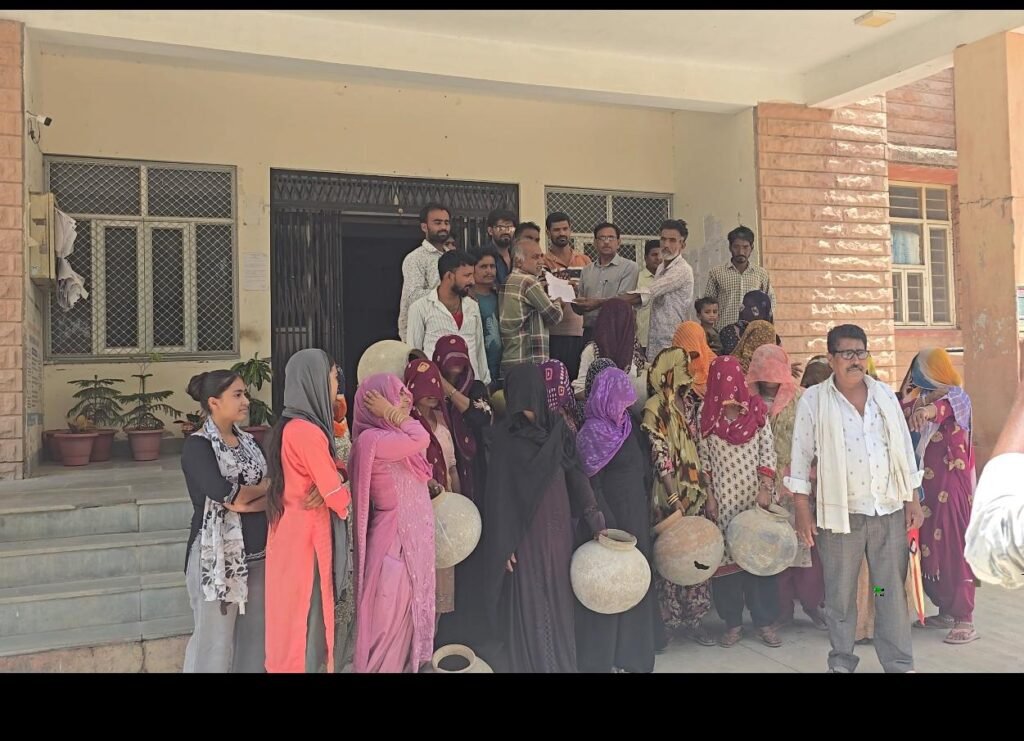
When water does arrive, it flows for thirty minutes to an hour through a single pipeline serving three neighbourhoods. Within that narrow window, it frequently cuts off – a technical failure, a power outage, a pressure drop. Three mohallas. One line. Half an hour. When it works. The women of Pichiyak have submitted memorandum after memorandum to the authorities. They have approached their MLA, who has not responded. They gathered – women with empty pots and steel buckets, a visual so plainly eloquent it required no translation – outside the SDM office in Bilara, demanding to be heard. The official response, captured on record, was:
“Gaon ki samasya ke anusar aapki samasya hai.”
Your problem is as per your village’s problem.
A bureaucratic shrug dressed as a sentence. In other words: we know, we don’t care, this is simply how things are. Their demands are not revolutionary. They are not asking for a swimming pool or a private borewell. They are asking for a pipeline that reaches all three neighbourhoods – six lines where there is now one – and a minimum of four to five hours of water supply at least three days a week. That is the ceiling of their ambition: water, three days a week, for a few hours. And even this the system cannot deliver to people living in the shadow of the district’s largest dam.
| “Ghar mein bachon ke liye do bucket paani bhi nahi hai. There are not even two buckets of water at home – not even for the children.” – A resident of Pichiyak village, Bilara tehsil, Jodhpur, at the SDM office |
When officials are pressed, they offer the oldest answer in the administrative playbook: “Aaj de denge, kal de denge.” We will give it today; we will give it tomorrow. Tomorrow has never arrived in six months. And there is a darker pattern beneath even this. Kailash Kharwal, a social activist from Pichiyak village who has spent years documenting the crisis, names it plainly:
“Whenever there is an agitation, whenever people protest, the authorities arrange a temporary water supply by tanker – just enough to end the protest. But the root problem remains untouched.”
The tanker arrives. The crowd disperses. The cameras leave. The pipe stays broken. And next month, the same women gather again outside the same office, holding the same empty pots, filing the same memorandum – because the system has learned that temporary relief is cheaper than permanent solutions, and that the poor have short institutional memory when their throats are dry.
Kharwal’s assessment carries the weight of lived observation: “The water problem is not only ours — it is the problem of the entire western Rajasthan. Especially in the summer months, local villagers suffer enormously. This problem has not been solved for years. Governments and officials come, given assurances, complete their tenures, and leave. But the problems of water and fluoride never end. We appeal to the government and administration to resolve this at the earliest.” He has been making this appeal for longer than most officials have been in their posts. None have answered it with anything other than a tanker and a promise.
Leela Devi Dewasi, the Sarpanch of Jaswantpura, gives the crisis its most precise and painful framing. “Our village is situated right on the banks of the dam,” she says, “and yet the people of our village are fighting water problems. We request the government and administration to make regular arrangements for the supply of clean drinking water.” Her village is not beside a river. It is not near a canal. It is on the banks of the dam itself – the largest reservoir in Jodhpur district – and its residents have no clean drinking water. There is no more damning single sentence available to describe the governance of water in western Rajasthan.
Pichiyak is not an outlier. It is a precise, close-up portrait of a failure that stretches across hundreds of villages in western Rajasthan – villages far more remote, with far less access to the SDM’s office, far less ability to gather in protest, far less chance of anyone writing about them at all. If this is what happens four kilometres from power, imagine what happens forty kilometres from it. Or four hundred.
THE POISON THE GOVERNMENT INSTALLED
In the 1980s, the government replaced ancient open stepwells with tube-wells and hand pumps drawing from deeper aquifers – hailed as modernisation. What no one adequately tested was what those aquifers contained. Western Rajasthan sits atop rock formations saturated with fluoride, arsenic, and heavy metals. Researchers have recorded fluoride concentrations as high as thirty-seven milligrams per litre in Rajasthan’s groundwater – nearly twenty-five times the WHO safety limit. In tribal villages where concentrations reach five parts per million, every single child has dental fluorosis. Limb deformities, bowed legs, and twisted joints are common sights in primary school classrooms. In Sambhar block, just fifty kilometres from Jaipur, the disability rate is twice the national average. In one school in Devpura village, six of thirty children have disabilities. Fluorosis damages bones, kidneys, thyroids, and – in children – the developing brain. It is irreversible. There is no cure. The hand pump that caused it still runs, still painted government-green, dispensing its slow destruction every morning.
Over four million people in Rajasthan suffer from fluorosis – the highest of any Indian state. Nationally, roughly thirty-seven and a half million Indians are affected by waterborne diseases annually. Seventy-three million working days are lost each year to water-related illness, draining six hundred million dollars from an economy whose poorest bear the entire weight of that loss. Waterborne diseases have caused over ten thousand deaths in India in just five years since 2017. Diarrhoea remains the second leading cause of death in children under five. In western Rajasthan, where ninety percent of rural drinking water comes from contaminated ground, these are not national statistics – they are the children in these villages.
A GROUND THAT IS SINKING
Beneath the contamination lies a second catastrophe: the aquifers are running out. As of 2024–25, two hundred and fourteen of Rajasthan’s three hundred and two assessed groundwater blocks are overexploited. Only twelve percent remain safe. The state extracts water at a hundred and forty-seven percent of its annual recharge rate – second worst nationally. In 2024, Rajasthan received a hundred and fifty-six percent of its long-period average rainfall – a near-record monsoon – and groundwater levels still fell. The earth is so hollowed out it can no longer absorb the rain it receives.
In Barmer, thirteen hundred crore rupees were spent over three years on forty-seven thousand recharge structures. The Central Ground Water Board (CGWB) recorded a net decline in groundwater regardless. Then the land began to sink: a pit ninety feet deep opened in Sahajrasar village, Bikaner, narrowly missing a passenger train. Parallel cracks tore through a kilometre and a half of Barmer’s surface. The CGWB had been issuing warnings about this overexploitation since 1987. Thirty-eight years of documented alarm. No adequate response.
PROMISES, MAFIAS, AND THE WOMEN LEFT STANDING
The Jal Jeevan Mission promised piped water to every rural household by 2024, backed by forty-two thousand crore rupees. In western Rajasthan, pipes were laid and left unconnected, tanks built without source water, certificates filed while villages drew from the same poisoned borewells. In April 2025, former Chief Minister Vasundhara Raje rebuked officials in Jhalawar over the scheme’s failure: “Give the account for every penny.” The account has not been given. Meanwhile, private tanker operators drill unlicensed borewells, harvest water from public ponds belonging to village Panchayats by law, and sell it back at whatever price desperation allows – without permits, purity tests, or oversight of any kind.
For the poorest families, there is only the walk, or the wait outside an SDM office with an empty pot. In documented cases across western Rajasthan, families survive on one litre of water a day. Women spend four to six hours daily fetching water, losing education, income, and health in the process. A 2021 study found that one person in twenty-eight percent of Rajasthani households has already migrated due to water and climate stress. Kanha Singh Fauji, eighty-two, a retired soldier from Bikaner, cannot walk — immobilised by fluorosis from the hand pump his government installed. Bhikharam, sixty-three, from Sikar, abandoned his farm; his sons are in Surat. And in Pichiyak, three neighbourhoods of women stand outside a government office, four kilometres from a dam, holding pots that have been empty for eight days, being told their problem is as per their village’s problem.
WHAT WAS DESTROYED, WHAT MUST BE DONE
The deepest irony is this: Rajasthan’s communities were never helpless. For millennia they built johads, khadins, baolis, and taankas – rainwater harvesting systems that sustained life through the same arid conditions now called an unmanageable crisis. The government declared them backward, replaced them with borewells, and walked away. Now NGOs like GRAVIS are rebuilding over two thousand such structures across five hundred villages, and water availability is climbing from four months a year to ten. The knowledge was never lost. It was ignored — because old knowledge does not generate tender fees.
Western Rajasthan needs no more reports. It needs Pichiyak’s single pipeline replaced with six, today, not after the next agitation. It needs the MLA who ignored repeated petitions named and held accountable. It needs Nand Kishore’s water department to answer why a village four kilometres away has been without water for six months. It needs the forty-two thousand crore Jal Jeevan funds independently audited. It needs the tanker economy regulated. It needs contamination maps published in local languages and acted on by law. And it needs someone in power to understand that a tanker sent to silence a protest is not governance – it is its opposite.
Kailash Kharwal has been saying this for years. Leela Devi Dewasi has been saying it from the banks of a dam. The women of Pichiyak have said it with empty pots outside an office four kilometres away that might as well have been four thousand. India has sent spacecraft to the Moon. It cannot send clean water to a village within sight of its own reservoir. That is not a failure of technology or resources. It is a failure of conscience – deliberate, sustained, and entirely reversible. The dam stands full in the distance. The pots stand empty in the women’s hands. The pipeline runs to one place only: nowhere.
— End of Report —